
This presentation was given at MLA 2023 for a panel called “Innovative Approaches to Editions and Edition Building in the Classroom.”

Ever since I started learning about scholarly editing, I have appreciated that editing was a way of knowing. Presenting a text was the best way of studying it and understanding it more fully (even when an edition already existed). This sense of stewardship was pleasurable—the responsibility was energizing. The idea of students as editors, which Wyn Kelley introduced at the 2013 meeting of the Melville Electronic Library, planted the seed for the project I’m describing today.
Editing in the Open is an interdisciplinary project designed to bring edition-building into undergraduate courses in the liberal arts. I can imagine the approach working well for courses offered to students majoring in the humanities, but it was designed to support a core curriculum initiative at The University of New Haven—a school known for its strong professional degree programs in field like criminal justice, forensic science, and cybersecurity. I have tested the approach I will be describing here over two semesters with freshmen of all majors in my first-year writing courses. Our revisions to the core curriculum at the university were inspired by Purdue’s Cornerstone initiative (funded by Teagle and the NEH), which places “transformative texts” more purposefully at the center of general education courses in the humanities. I’ve adapted this approach for our Connected Core initiative. While students may be transformed by the texts we work on, I want to emphasize that we can empower students to transform these texts and, in so doing, determine afresh how they are relevant to their lives and career goals.
I imagine that all of you might think of yourselves as fully immersed in scholarly editing given the title of this panel. You may be working on grant-funded editing projects and be well-versed in XSLT. Maybe we can have a show of hands (who feels comfortable with XSLT in the audience today? Who has funding to pay an XSLT expert?). I’ve never been able to collaborate with scholarly editors on a large project and I’ve often wished for that community. The closest I’ve gotten is a course I’ve taught twice on digital editing, in which students built editions that they published on TAPAS. Perhaps because of this, I have long wanted to persuade my colleagues who don’t know about the TEI to join me. A few years ago, this didn’t seem at all possible. If I found the work challenging and time-consuming with no clear path to publication, why would my colleagues with heavy teaching loads somehow be willing to invest their energy? But something clicked during the pandemic, as I learned more about open educational resources through the Rebus Textbook Success Program. I realized that an editorial community need not be restricted to a single editorial project. A group of faculty could collaborate around the practices needed to build editions with their students. Editing in the Open is becoming a community and, soon, a guide for building editions that grow each semester through student contributions.
I am going to guess that even those of you at the center of scholarly editing can imagine colleagues you would like to bring into the practice. So I hope you’ll join me in imagining for a moment, a colleague in the liberal arts who you think might be interested in trying something like this. What would it take to help them engage with editing as a method of knowing? Mainly, I want you to think about how these colleagues might respond to the pitch I’m about to make and, of course, how you respond to the somewhat unconventional approach to edition-building that I’m advocating here.

So, to get started, we need to tackle why an instructor would decide to build an edition with students instead of assigning (or photocopying or copy/pasting) a reliable edition for their students? We all copy texts in our teaching. And many in the room will likely have started to use digital tools to encourage students to annotate readings collaboratively. This has been my favorite strategy for promoting engaged reading since I learned about Annotation Studio in 2013 and then shifted to Hypothesis in 2016. But edition-building is different than copying, even when encouraging social annotation. My goal is student assignments that involve an opportunity to shape an edition—correcting transcription errors, developing prosopography, and preparing annotations that will be used by future students in the course.

I do this because I believe students are more engaged by the task of building new knowledge than they are by consuming what is already known. Despite this pedagogical commitment, my training in scholarly editing made me hesitant to use an in-process edition in the classroom. I was encouraged, however, by the many open pedagogy practitioners who use this approach. In their introduction to open pedagogy, Robin DeRosa and Rajiv Jhangiani remind us that “knowledge consumption and knowledge creation are not separate but parallel processes, as knowledge is co-constructed, contextualized, cumulative, iterative, and recursive.”[1] David Wiley’s promotion of “renewable” over “disposable” assignments helped me think through the importance of a real audience for the work students do in my courses and prompted me to find ways to incorporate student annotations into editions used in the future.[2] Catherine Cronin’s work on student rights in the open learning environment has helped me guide students to decide IF they want to share their work in a class edition, HOW they will license their work, and how their names will appear in the project.[3] Because my goal is not a complete edition but a powerful learning experience, I encourage students to formulate their own research questions to guide their contributions.

Not only do students engage with the text more meaningfully when they think of themselves as stewards of it, but they also encounter real issues of reliability as we get acquainted with the many digital copies and editions of texts that proliferate on the web. Students develop web literacy skills while engaging in the sort of book history that we would not typically bring into an introductory writing course. I try to teach the strategies Mike Caulfield encourages in Web Literacy for Student Fact Checkers, which is designed to address “a set of real problems students confront daily: evaluating the information that reaches them through their social media streams.” For these daily tasks,” Caulfield explains, “students need concrete strategies and tactics for tracing claims to sources and for analyzing the nature and reliability of those sources.” When we’re reading versions of little red riding hood at the start of the semester, for example, I can show students that Project Gutenberg has a copy of Andrew Lang’s blue fairy book that does not make clear which edition it uses as its source text and that the folklorist D.L. Ashliman’s website, with its abundant notes, has added the moral onto Perrault’s tale when it didn’t appear in the source text he cites. This reinforces the idea that everything needs verification (and is the reason I insist that all contextual markup in our open editions be verifiable through clear citations).
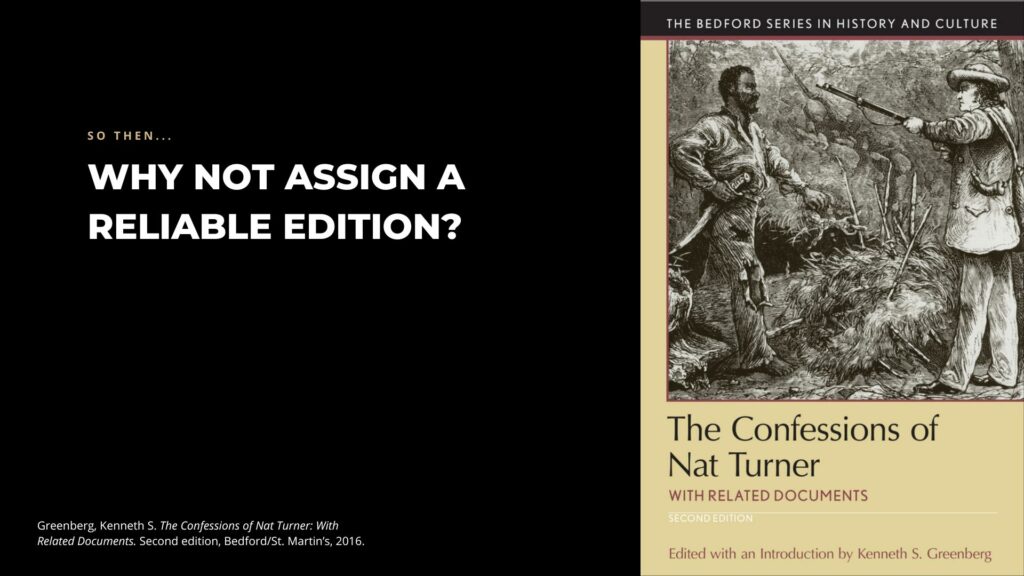
Given the importance of reliability, why would a professor not want students to read a text with a rigorous scholarly edition, if one exists?

I choose to build editions because I think it creates an engaging learning experience—especially for students who don’t come into my required English course convinced that they want to engage. Fundamentally, scholarly editing as a technology of curation orients us to the text in a particular way, much as writing as a technology of knowing orients one toward one’s own thoughts. I adapt here the popular concept of writing to learn vs. learning to write from the domain of writing pedagogy to apply also to editing and publishing (a technology of sharing).[4] Writing, editing, and publishing provide ways of thinking even before students are being taught HOW to write, edit, or publish. Acting as a steward of a text puts students in a position to decide if and how it is relevant to them, which can be liberating.
[okay, here ends my pitch to my colleagues and your colleagues, if you’ve played along. If I’ve been persuasive, the next challenge is to show our colleagues that this is possible.]

As we turn to technical considerations, it is useful to bring in recent discussions about minimal computing, which Roopika Risam and Alex Gil have beautifully articulated as connoting “digital humanities work undertaken in the context of some set of constraints.” Though a digital resource might lower students’ textbook costs, building an open edition (or any OER or digital humanities project) is not free; it requires resources that not all faculty can access. The faculty I most want to reach with this project are those without the technical experience or time to invest in learning the TEI, much less the XSLT and hosting considerations to publish it should they make it to that stage. With this in mind, I want to draw our attention to the four questions Risam and Gil propose we consider when taking a minimal computing approach to digital projects. The first question is “what do we need?” to which I answer “we need open documentary editions of humanities texts that can grow and change with contributions from students.” Important here is the fact that each edition represent a specific document—they are not “critical editions”—and they do not need to be complete before being used in the classroom. Next, we ask, “what do we have?” and for this I think about the quality of existing digital editions, the availability of digital facsimiles, and the accessibility of publication platforms. The third question is, “what must we prioritize” and I have decided to prioritize a public repository, page images, human-readable metadata, assignments that encourage students’ editorial contributions while protecting their rights, and practices that allow faculty to move toward the TEI if they choose. The final question is “what are we willing to give up?” and I think you can probably guess that I might not think learning the TEI is the first step.
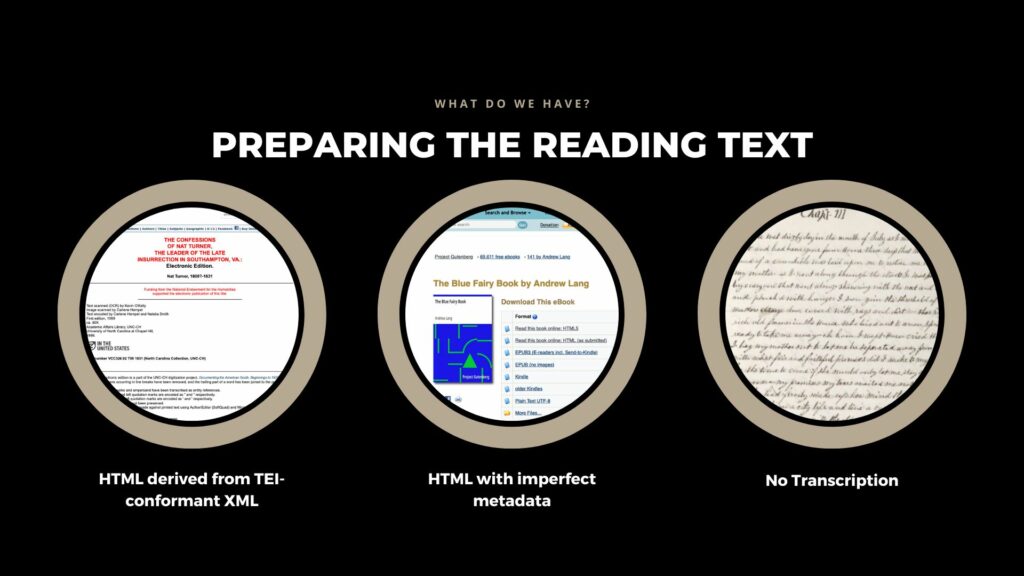
So, what did I have when I prepared my edition of The Confessions of Nat Turner? I used WorldCat in search of the first printing and was lucky to find a TEI edition produced by the team at the Documenting the American South project in 1999. I downloaded the html from the website, saved the file to a GitHub repository, and then removed the header and other features unique to the DocSouth site. I then incorporated html tags for a thumbnail page image linking to a full-size page image and footnotes that my students composed in our first semester of studying the text together. I discovered (but did not remove) a few transcription errors to see what my students would make of them when working with the edition. Another option is to use an imperfect transcription for the first iteration (this might seem irresponsible if it weren’t for the page images). When I prepare a short edition of Charles Perrault’s Little Red Riding Hood as it appears in the 1889 edition of Andrew Lang’s Blue Fairy Book, I will be copying the text from the Project Gutenberg e-text because it is a better starting point than the messy OCR extracted from the image files at Internet Archive. This will allow students to correct any inaccuracies against the page images. For texts that have not yet been transcribed, the first use in the classroom could involve sharing a digital facsimile with students and then inviting them into the work of transcribing in Markdown. Markdown would work well here because it is fairly straightforward while still allowing a discussion of descriptive vs. presentational markup. And it can be converted to TEI lite with pandoc should the editor want to move into the TEI. I’m planning to use this strategy when teaching a course called “Representations of ‘the Criminal’” next year. In that course, I’ll work with students to begin an open edition of Austin Reed’s The Life and The Adventures of a Haunted Convict because I think the task of transcribing his handwritten memoir will be impactful.

I think page images are crucial to the integrity of an in-process open edition. Beyond the verifiability they provde, their presence in the reading text is a constant reminder that what is being read in an attractive font on a white background existed previously in another format. When looking for pages images for an edition of The Confessions, I discovered that in 2013, librarians at the UNC-Chapel Hill library facilitated the scanning of the same copy of the text that had been used for the TEI edition in 1999 and uploaded them to Internet Archive.[5] I was able to download a zipped folder of the high-quality image files from Internet Archive and compress them for use as page images. There are many scenarios I can imagine where a faculty member would want to build an edition of a text that has not yet been professionally scanned. I include here a page image from The Young Idea, because my work on a documentary edition of that text prompted me to use my phone to capture images of the copy I had bought with grant funds. This project has already led me to colleagues who have taken similar approaches to introducing their students to rare books (that is, purchasing them with small grants and taking images on their own).
Ideally, I’d be able to use a IIIF manifest instead of creating additional copies of these image files, but I’ve yet to solve the mystery of accessing IIIF manifests for artifacts represented in the Internet Archive (I’ve heard it should be possible!), nor have I yet figured out how a manifest might work practically with my goals for a reading text. I plan to tackle these questions when I teach Reed’s The Life and The Adventures of a Haunted Convict, which does have a IIIF manifest. Once I’ve navigated these challenges, it seems possible that working with a IIIF manifest might be simplest of these three image file scenarios to navigate, but for now it seems as complicated as a using static site generator like Jekyll.

And this leads me to publishing the edition, though I won’t start with Jekyll. Instead, I’ll start with the opposite end of the spectrum by noting that I was told early in my exploration of the digital humanities that WordPress and other content management systems wouldn’t be a good idea for a scholarly edition. I took that advice and poured tons of energy into the TEI, but I now think that advice needs some qualification. I still don’t think it would be wise to do all of the work to build an edition in WordPress (as I mentioned above, if you’re starting without a transcription, I think Markdown makes the most sense), but it can work as a place to publish the HTML that has emerged from an existing TEI edition. More specifically, I think Pressbooks (a content management system built on WordPress), is an excellent choice for an edition built from an existing TEI edition.

Here you can see what the confessions looks like in Pressbooks. [6]

I was also delighted this summer to learn that in a matter of minutes, one can turn a text encoded with Markdown into an edition with pages images saved in the repository using only GitHub Pages. Like IIIF, I have big dreams about using a static site generator and I value the shift away from CMSs, but that is going to have to wait until I have an edition that needs something more than what I can do with GitHub Pages.

I want to conclude by sharing an epiphany I had this summer while on a hike. Trails up a mountain don’t just exist. People build them so others can experience the challenge of climbing up a mountain. Sometimes, this just means leaving a trail blaze for those in the future to follow.

But sometimes (more like, most of the time), trail maintenance is hard (and expensive) work! Significant resources have been invested to make it possible for us to struggle up a mountain. I had research funding that allowed me to hire Christopher Ohge for digital consulting and programming work as I sought the simplest paths forward for open iterative editions. I realized as I scrambled up Mt. Hunger this summer that I wasn’t investing resources in removing the difficulty—just offering a path to navigate the difficulty.

Because the summit is worth it. In this metaphor, the summit is the edition. And the hike makes the summit more satisfying! And you’re going to go back down the mountain and hike right back up again with the next class. You see what I mean? Hikes are iterative.

Now, the plot thickens. A road (something like a content management system like Pressbooks) might get you to the top. The famous Mount Washington auto road in New Hampshire makes it possible to visit the summit without hiking the mountain. And my theory is that my colleagues (the ones I want to lure into the world of scholarly editing) have to experience the summit (and perhaps get a sense of what they’d be missing if they stayed on the road) to get excited enough to try the hike. To these colleagues I say “The first iteration of your edition can be built very simply in Pressbooks and the satisfaction of having created something that supports your pedagogy will be addictive.”

But some believe that driving to the top of a mountain is not ideal. And for the longest time, I was stuck because it seemed like blasphemy to talk about Pressbooks with scholarly editors. But I’m doing it. So there. It’s okay to drive to the top of the mountain.

Because with great trails and roads, you can just hike a little, when you’re ready. No pressure. What you see here is the “don’t stress out, we’ve got you” cycle. Faculty editing in the open will be invited to edition-building events each summer and January to collaborate while revising their editions.

Like the community of hiking enthusiasts who volunteer to move massive rocks and cut back vegetation in national parks, I’m hoping to gather a community of faculty members who are building editions with their students. Techniques and publication platforms will change. This group will adjust. We’ll probably seek the expertise of those who undertake much more complex editions. And we’ll likely be much more effective with grant funding. This group will be in the perfect position to maintain and blaze the trails. That is, to make the sort of documentation Quinn Dombrowski calls for in her recent critique of minimal computing.

She explains, “Descriptions and flowcharts about where minimal computing approaches make more or less sense would be extremely valuable to help steer scholars to a suitable technical path. Step-by-step tutorials, particularly ones written without any assumption of prior technical knowledge, can make a tremendous difference in facilitating scholars’ independent use of minimal computing practices.” I’m working now on a branching scenario to help folks navigate the many questions that emerge when putting an edition together. Let me know if you’d like to contribute a tutorial.
[1] Robin DeRosa and Rajiv Jhangiani, “Open Pedagogy,” in A Guide to Making Open Textbooks with Students (The Rebus Community for Open Textbook Creation, 2017), https://press.rebus.community/makingopentextbookswithstudents/chapter/open-pedagogy/.
[2] The initial blog post introducing the concept is found in David Wiley, “What Is Open Pedagogy?,” October 21, 2013, https://opencontent.org/blog/archives/2975. A more thorough exploration may be located here: David Wiley and John Hilton, “Defining OER-Enabled Pedagogy,” Faculty Publications, September 26, 2018, https://doi.org/10.19173/irrodl.v19i4.3601.
[3] Catherine Cronin, “Open Education, Open Questions,” Educause Review, October 23, 2017, https://er.educause.edu/articles/2017/10/open-education-open-questions.
[4] Fulwiler, Toby, and Art Young. “Introduction.” Language Connections: Writing and Reading Across the Curriculum – The WAC Clearinghouse, 2000, https://wac.colostate.edu/books/landmarks/language-connections/.
I should also mention that Angus Fletcher’s work on narrative as a technology of thinking fits in here, but it hasn’t all clicked together yet for me. We all know that you can use a technology without being able to create it.
[5] Nat Turner and Thomas R. Gray, The Confessions of Nat Turner, the Leader of the Late Insurrection in Southampton, Va. : As Fully and Voluntarily Made to Thomas R. Gray, in the Prison Where He Was Confined, and Acknowledged by Him to Be Such, When Read before the Court of Southampton . . . , &c (Baltimore : T.R Gray, 1831), http://archive.org/details/confessionsofnat00turn; Thomas R. Gray, “Nat Turner, 1800?-1831 The Confessions of Nat Turner, the Leader of the Late Insurrection in Southampton, Va.,” Documenting the American South, 1999, https://docsouth.unc.edu/neh/turner/menu.html.
[6] It wasn’t always the case, but a recent shift in their pricing structure means that the full-featured version of Pressbooks, complete with inclusion in the Pressbooks Directory that facilitates the remixing of OER, is affordable for faculty who don’t have access to a university networked pressbooks account. I will just say that I tried hosting pressbooks myself before my university established a network and was VERY grateful for my commitment to a github repo when I encountered a user (me)-made catastrophe.
